Cleaning Open-Plan Offices vs. Cellular Layouts: The Operational Differences That Matter

Does office layout actually change how a space needs to be cleaned? The short answer is yes – and the implications run deeper than most facilities managers might expect. A contractor who approaches a floor of enclosed private offices the same way they approach an open-plan trading floor isn’t just being inefficient; they’re applying the wrong operational logic entirely. Layout determines contamination patterns, dictates access constraints, shapes equipment choices, and directly affects how many hours a cleaning programme realistically requires. Across Greater London’s enormous variety of commercial stock – from Georgian townhouse conversions carved into cellular suites to vast open-plan floors in glass towers along the Thames – this distinction is one of the most consequential variables a cleaning contractor has to manage. This article breaks down exactly what changes, and why it matters.
Two Layouts, Two Cleaning Realities
What Defines an Open-Plan Office (Operationally)
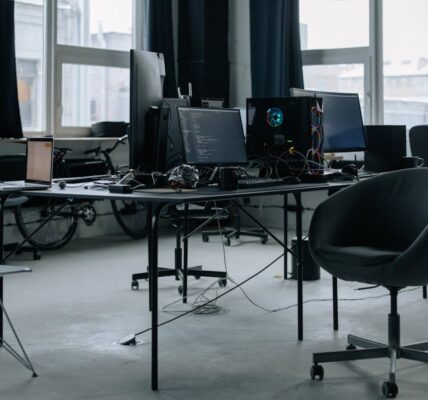
From a cleaning standpoint, an open-plan office is characterised by large, undivided floor plates with minimal physical boundaries between workstations. Desks sit in open clusters or rows, collaborative zones bleed into quiet areas, and breakout spaces share the same uninterrupted square footage as individual work points. There are no doors to unlock, no thresholds to navigate, and no compartments to track. For a cleaning operative, this means unobstructed movement, high surface-area continuity, and – critically – a significant concentration of shared touchpoints across a space that may be occupied by dozens or hundreds of people every day.
What Defines a Cellular Office (Operationally)
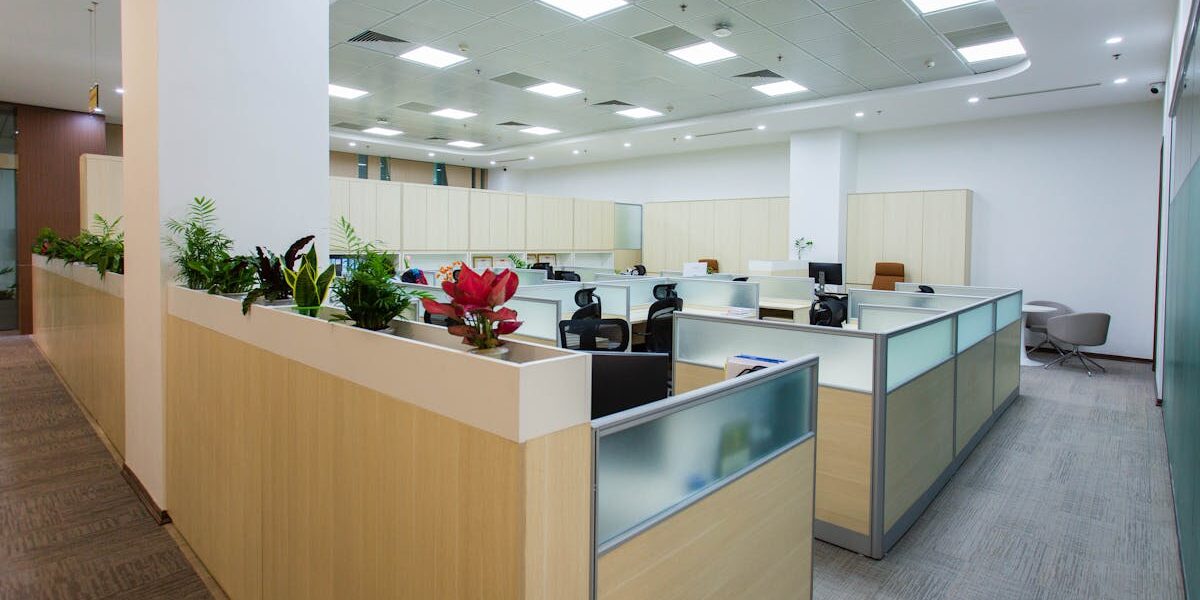
Cellular offices are defined by compartmentalisation: individual rooms, enclosed private offices, and partitioned suites where each space functions as its own micro-environment. The floor plan is fragmented by design, and that fragmentation has direct operational consequences. Each room must be accessed, assessed, and cleaned independently. Occupancy levels vary dramatically from room to room – a senior partner’s office may be occupied all day while the room next door sits empty for a week. For a cleaning team, this is a fundamentally different proposition to managing one large open space, regardless of whether the total square footage is identical.
Contamination Patterns and High-Touch Surface Mapping
Open-Plan – Shared Everything, Spread Quickly
In an open-plan environment, contamination travels fast and covers ground. Hot-desking – now standard in most contemporary London offices following the shift to hybrid working – compounds this considerably. A surface wiped at the end of the evening may be occupied by three different people the following day, each bringing their own contamination load. The high-touch hotspots in open-plan layouts are numerous and densely clustered: shared monitors and docking stations, communal charging points, collaborative furniture such as moveable whiteboards and shared booth seating, printer and photocopier stations, and the arms and surfaces of any communal seating. The sheer density of shared contact points means that methodical, consistent disinfection protocols are not optional extras here – they are the structural backbone of what effective open-plan cleaning looks like.
Cellular – Contained, but Easy to Overlook
Enclosed offices create a particular problem that open-plan spaces do not: the illusion of cleanliness. If an occupant is tidy, their room can look presentable while harbouring significant contamination on frequently touched surfaces. Door handles, light switches, window latches, and internal blinds become disproportionately significant in cellular layouts – these are the touchpoints that accumulate contact from every person who enters, yet they are the easiest to miss in a room that otherwise appears orderly. Single-occupancy rooms can also mask irregular cleaning cycles. Without a visible accumulation of mess across a wide floor, a cellular room that was last properly cleaned three days ago may show no outward sign of it. Frequency auditing – verifying not just that rooms were entered but that the correct tasks were completed – is therefore more important in cellular environments than almost anywhere else.
Scheduling, Access, and Workflow Logistics
Open-Plan – Speed, Scale, and Sequencing
Open-plan floors lend themselves to efficient, linear cleaning workflows. A team can work across a large floor simultaneously without operatives getting in each other’s way, and wide-area equipment can cover significant ground in a single continuous pass. Route sequencing on open floors follows a logical, zoned pattern – typically working from the furthest point back toward the exit to avoid treading over cleaned areas. Out-of-hours scheduling is also considerably more straightforward in an open-plan environment: once access to the floor is granted, the entire space is available. There are no individual rooms to account for, no internal doors to check, and no risk of finding a section of the floor inaccessible because a meeting room was locked at the end of the day.
Cellular – Door-by-Door Complexity and Access Challenges
Cleaning a cellular office building is operationally closer to cleaning a hotel corridor than an open warehouse floor. Each room must be individually accessed, assessed for current occupancy or use, and cleaned before the operative moves on. In occupied buildings – particularly in London’s many professional services and legal offices where late working is routine – rooms may be in use well into the evening, locked by individual occupants, or simply inaccessible without prior key management arrangements. Master key protocols, room-by-room checklists, and clear communication with building management are not administrative niceties in cellular environments; they are operational necessities. The per-square-metre dwell time is substantially higher than in open-plan layouts, and staffing ratios must be calculated accordingly. A direct comparison based purely on total floor area will produce unreliable estimates every time.
Equipment and Product Selection
Tools Built for Open Terrain
Open-plan floors justify investment in wide-area equipment that prioritises coverage speed. Backpack vacuum systems allow operatives to move continuously without repositioning a unit, while auto-scrubbers and scrubber-dryers can cover large hard-floor areas – increasingly prevalent in contemporary London commercial builds – in a fraction of the time a traditional mop-and-bucket approach would require. Microfibre flat-mop systems offer an effective middle ground for medium-sized open floors where a full scrubber-dryer would be excessive. The principle driving equipment selection in open-plan environments is scale efficiency: every piece of kit should be chosen for its ability to maintain quality standards while minimising the time required to cover the available ground.
Compact, Manoeuvrable, Consistent in Tight Spaces
Cellular offices demand a different kit philosophy entirely. Compact cylinder or upright vacuums that can be carried through doorways and repositioned quickly are the practical standard. Handheld tools, spray-and-wipe protocols, and caddy-based chemical systems that allow an operative to carry everything they need for multiple rooms without returning to a central trolley are all worth the investment. The key challenge in cellular cleaning is not speed – it is consistency. Ensuring that each enclosed space receives the same standard of clean, with no surfaces skipped because a room looked tidy or because the operative was working against the clock, requires disciplined checklisting and well-structured SOPs. Trolley configuration also changes: navigating corridors and narrow doorways calls for smaller, more manoeuvrable setups than the large flat-bed trolleys that work well on open floors.
Staffing, Time Allocation, and Productivity Benchmarks
One of the most commercially significant differences between the two layout types is their effect on labour productivity. Open-plan floors typically deliver higher output per operative hour – measured in square metres cleaned – because movement is unimpeded and equipment can work at full efficiency. Cellular layouts carry hidden time costs that do not show up in a square-footage calculation: unlocking and relocking doors, repositioning equipment between rooms, adjusting to varying levels of clutter and occupancy, and mentally tracking which rooms have been completed against a checklist. These micro-costs accumulate rapidly across a building with thirty or forty enclosed offices. A professional contractor working across London’s varied commercial stock will generally apply different productivity benchmarks to each layout type – not as a margin protection measure, but because applying the same benchmark to both produces either an underfunded programme or a client being charged for time that isn’t required. Transparency about this distinction is a mark of operational maturity.
The Hybrid Reality – How Most London Offices Actually Work
The clean binary of open-plan versus cellular rarely reflects what a contractor actually walks into on a London commercial site. Most modern offices combine both – open-plan work floors sitting alongside enclosed meeting rooms, director suites, breakout pods, server rooms, print rooms, and welfare facilities. Each zone type carries its own operational logic, and treating the building as a single uniform environment will produce uneven results. Operationally astute contractors handle hybrid layouts through zoned cleaning schedules that identify each distinct area type and assign the appropriate methodology, staffing allocation, and equipment accordingly. Split-team workflows – where one operative works the open floor with wide-area equipment while another works the cellular perimeter room by room – can significantly improve both efficiency and consistency across mixed-layout buildings. For facilities managers procuring cleaning services across Greater London, this is where the difference between a capable contractor and a genuinely specialist one becomes most visible: not in the quote, but in whether the methodology presented reflects the actual complexity of the building in front of them.
The Space Dictates the Standard
Layout is not a passive backdrop to cleaning operations. It actively shapes what good cleaning looks like, how long it takes, what equipment it requires, and how it should be measured and audited. A cleaning programme designed without reference to the architectural reality of the space it serves will always be compromised – either by inefficiency, by inconsistency, or by the quiet accumulation of areas that are never quite receiving the attention they need. The most useful question a facilities manager can put to any current or prospective contractor is a simple one: how does your methodology change depending on the layout of the space? The answer – or the absence of one – will reveal a great deal about whether the programme being delivered is genuinely fit for purpose.